Disclaimer: This calculator is for informational and illustrative purposes only and should not be considered financial advice. Pension projections are estimates based on the parameters you provide and do not guarantee future performance. Investment returns can vary significantly, and past performance is not indicative of future results. Tax rules and allowances may change. Please consult with a qualified financial adviser or pension specialist for advice tailored to your specific circumstances.
SIPP Pension Planner Tool (UK £)
You can use the SIPP Pension Planner Tool for free.
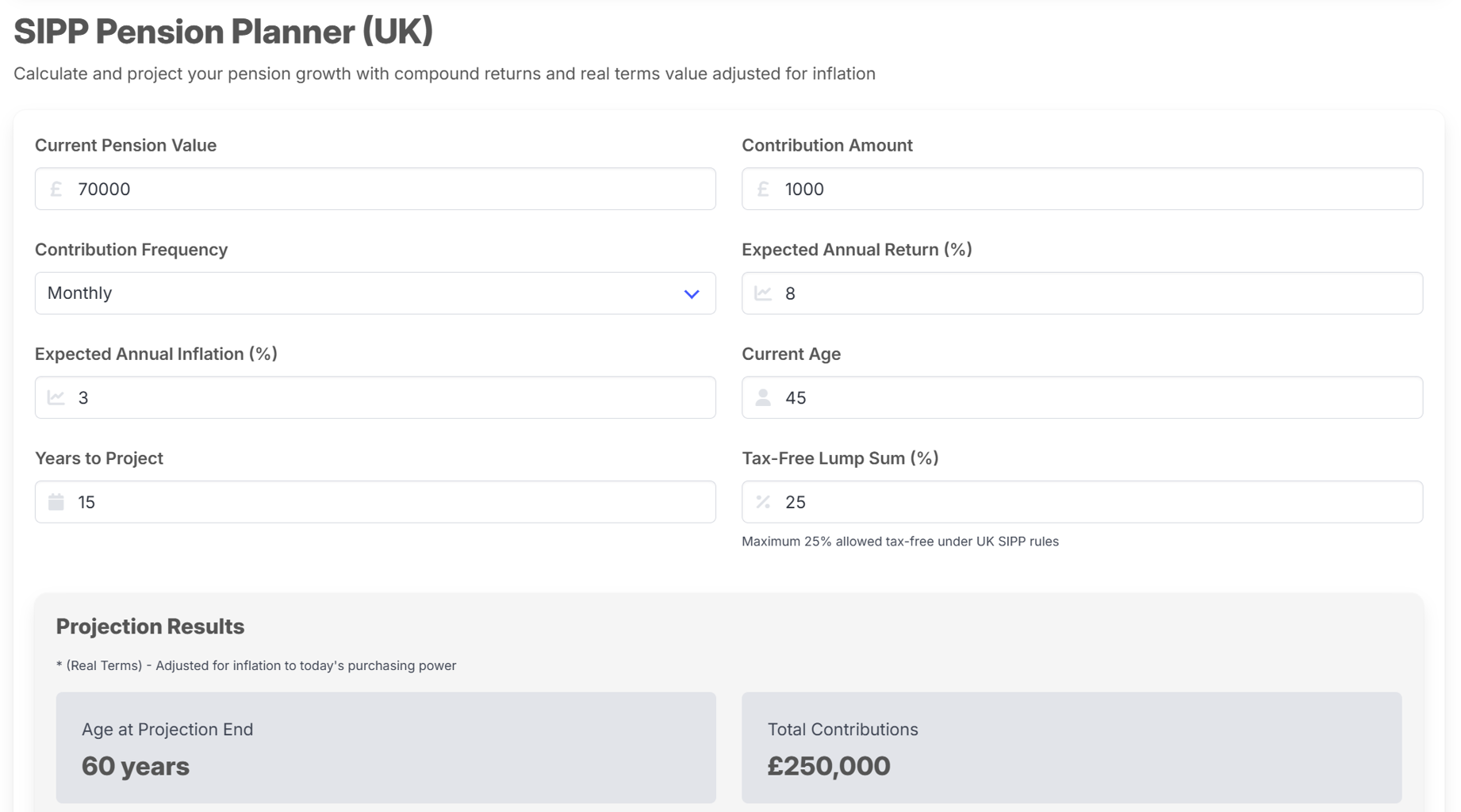
Key Features of the SIPP Pension Planner
1. Compound Growth Calculations
The calculator shows you how compound interest works in your favor over time. Your contributions earn returns, and those returns earn returns themselves, creating exponential growth over the long term.
2. Real Terms Adjustment
One of the most important features is the real terms value calculation. This shows what your pension will be worth in today's purchasing power after accounting for inflation. A £500,000 pension pot in 30 years might only have the buying power of £250,000 in today's money if inflation averages 2.5% annually.
3. Flexible Contribution Modeling
Choose between monthly or annual contributions and adjust the amounts to see how different saving strategies affect your outcome.
4. Tax-Free Lump Sum Calculator
UK pension rules allow you to take up to 25% of your pension pot as a tax-free lump sum. The calculator shows you this amount in both nominal and real terms, plus what remains for income drawdown.
5. Year-by-Year Breakdown
See detailed projections for every year, showing how your contributions, investment growth, and total value change over time.
6. Automatic Saving (for Registered Users)
If you sign in or register, your calculator parameters are automatically saved, so you can return later to review or update your projections.
How to Use the SIPP Pension Planner
Step 1: Enter Your Current Pension Value
Start by entering the current value of your SIPP pension. If you're just starting out, enter £0 or your initial contribution amount.
Example: £50,000
Step 2: Set Your Regular Contributions
Enter how much you plan to contribute regularly, and choose whether these are monthly or annual contributions.
Example: £500 per month (£6,000 annually)
Tip: The annual allowance for pension contributions in the UK is £60,000 (2025/26 tax year). The calculator will warn you if your contributions exceed this.
Step 3: Choose Your Expected Annual Return
This is the average percentage growth you expect from your investments each year. Historical stock market returns average around 7-10% annually, but past performance doesn't guarantee future results.
Conservative Estimate: 4-5%
Moderate Estimate: 6-7%
Optimistic Estimate: 8-10%
Example: 7% (a moderate long-term estimate)
Important: Higher returns come with higher risk. Consider your risk tolerance and investment strategy when choosing this number.
Step 4: Set Expected Annual Inflation
Inflation erodes the purchasing power of money over time. The UK's inflation target is 2%, but historical averages vary.
Example: 2.5% (slightly above the Bank of England's target)
Step 5: Enter Your Current Age and Time Horizon
Input your current age and how many years you want to project forward (typically to your planned retirement age).
Example:
- Current Age: 35
- Years to Project: 30 (planning to retire at 65)
Remember: You can typically access your SIPP from age 55 (rising to 57 from 2028), but many people work longer.
Step 6: Set Your Tax-Free Lump Sum Percentage
The default is 25%, which is the maximum allowed under UK rules. You can reduce this if you plan to take less as a lump sum.
Example: 25%
Understanding Your Results
Once you've entered all parameters, the calculator automatically displays:
Summary Metrics
- Age at Projection End: Your age when the projection period ends
- Total Pension Value (Nominal): The actual monetary amount you'll see in your pension statement
- Total Pension Value (Real Terms): What that money will be worth in today's purchasing power
- Total Contributions: How much you'll have paid in over the years
- Total Investment Growth: The difference between your final value and total contributions
Tax-Free Lump Sum
- Lump Sum (Nominal): The cash amount you can withdraw tax-free
- Lump Sum (Real Terms): What that lump sum will be worth in today's money
Remaining Pension Pot
After taking your tax-free lump sum, the calculator shows:
- Remaining Pot (Nominal): What's left for drawdown or annuity
- Remaining Pot (Real Terms): The purchasing power of the remaining amount
Year-by-Year Breakdown
A detailed table shows your pension's growth annually, including:
- Your age in each year
- Nominal value
- Real terms value
- Cumulative contributions
- Investment growth
Important Considerations
1. Investment Returns Are Not Guaranteed
The calculator uses your estimated return rate, but actual returns will vary year by year. Markets go up and down. Consider running multiple scenarios with different return rates to understand the range of possible outcomes.
2. Inflation Significantly Impacts Real Value
A 2.5% inflation rate over 30 years means prices roughly double. Always pay attention to the "real terms" figures when planning your retirement lifestyle.
3. Fees and Charges Not Included
The calculator doesn't account for:
- Platform fees
- Fund management charges
- Trading costs
- Adviser fees
These typically range from 0.2% to 1%+ annually and will reduce your returns.
4. Tax on Pension Income
While 25% is tax-free, the remaining 75% is taxed as income when you draw it. The calculator doesn't model this ongoing tax liability.
5. Life Expectancy Matters
Your pension needs to last throughout retirement. Average life expectancy continues to increase, so plan conservatively.
6. State Pension
The calculator only models your private SIPP pension. Remember you'll also receive the State Pension (currently £11,502 annually for the full new State Pension in 2025/26).
Using the Tool for Different Scenarios
Scenario Planning
Try running multiple projections with different assumptions:
- Best Case: Higher returns (8-9%), lower inflation (2%)
- Expected Case: Moderate returns (6-7%), average inflation (2.5%)
- Worst Case: Lower returns (4-5%), higher inflation (3-4%)
This gives you a realistic range of outcomes and helps you plan conservatively.
Contribution Experiments
Try adjusting your contribution amounts to see the impact:
- What if you increased contributions by 10%?
- What if you made a one-off contribution when you receive a bonus?
- How much do you need to contribute to reach a specific retirement target?
Retirement Age Comparison
Compare projecting to age 60 vs. 65 vs. 70 to see how working longer affects your pension pot.
Tips for Maximizing Your SIPP
1. Start Early
Time is your greatest asset. Even small contributions in your 20s and 30s can grow enormously due to compound interest.
2. Maximize Tax Relief
SIPP contributions receive tax relief at your marginal rate:
- Basic rate (20%): £80 contribution = £100 in pension
- Higher rate (40%): £60 contribution = £100 in pension (after claiming additional relief)
- Additional rate (45%): £55 contribution = £100 in pension (after claiming additional relief)
3. Don't Forget Employer Contributions
If you have a workplace pension alongside your SIPP, remember to account for those contributions too.
4. Regular Reviews
Review your pension at least annually:
- Are you on track for your retirement goals?
- Do you need to adjust contributions?
- Is your investment strategy still appropriate?
5. Diversification
Don't put all your eggs in one basket. Spread investments across different asset classes to manage risk.
6. Consider Professional Advice
For large pension pots or complex situations, a qualified financial adviser can provide personalized guidance.
Common Questions
Q: Is the calculator suitable for other pension types?
A: Yes, the calculations apply to any defined contribution pension (workplace pensions, personal pensions, etc.). The principles are the same.
Q: How accurate are the projections?
A: The calculations are mathematically accurate based on your inputs, but they're projections, not predictions. Actual returns will vary. Use conservative estimates and scenario planning.
Q: Should I take the full 25% tax-free lump sum?
A: It depends on your circumstances. The lump sum is tax-free, but leaving money invested may provide more growth. Consider your needs and tax situation.
Q: What return rate should I use?
A: Historic stock market averages are 7-10% annually, but past performance doesn't guarantee future results. Most advisers recommend using 5-7% for planning purposes. Lower is more conservative.
Q: Does the calculator account for changing contribution amounts?
A: Currently, it assumes fixed contributions. For varying contributions, you'll need to run multiple projections or use a spreadsheet.
Q: How does inflation vary by year?
A: The calculator uses a fixed inflation rate. In reality, inflation varies annually. Using an average (2-3%) is reasonable for long-term planning.
Getting Started
Ready to plan your retirement? Visit the SIPP Pension Planner to start projecting your pension's future growth.
If you create an account and sign in, your calculator settings will be automatically saved, allowing you to return and update your projections as your circumstances change.
Disclaimer
This calculator is for informational and illustrative purposes only and should not be considered financial advice. Pension projections are estimates based on the parameters you provide and do not guarantee future performance. Investment returns can vary significantly, and past performance is not indicative of future results. Tax rules and allowances may change.
Please consult with a qualified financial adviser or pension specialist for advice tailored to your specific circumstances.
About This Tool
The SIPP Pension Planner is a free online calculator built to help UK residents understand and plan their retirement savings. It uses compound interest calculations, inflation adjustment, and UK pension rules to provide realistic projections of your pension's future value.
No financial information is sent to third parties.